

Best Zero-Sequence Transformer: How to Choose the Right One
2026-08-29
Choosing a zero-sequence transformer isn't just about matching specs—it's about preventing nuisance tripping, reducing harmonics, and keeping equipment running when it matters most. Too often, generic options lead to overheating or missed ground faults. This guide strips away the technical fog and focuses on what actually drives performance: impedance, burden, accuracy class, and installation environment. Whether you're upgrading an existing system or designing from scratch, you'll come away with a clear framework for picking the right unit. For dependable zero-sequence transformers built for real-world demands, Lugao is a name worth knowing.
What a Zero-Sequence Transformer Actually Sees (and Why It's Not Just Another CT)
A zero-sequence transformer doesn't care about the total current flowing through each phase conductor. It looks at the vector sum of all three phase currents, and under normal balanced loading that sum is essentially zero. The magnetic fluxes produced by the three conductors cancel out inside the core, so the secondary winding sees almost nothing. When a ground fault develops, even a small one, the return path through earth creates an imbalance. That imbalance shows up as a net flux, and the transformer detects it as a zero-sequence current. It's not measuring how much current is moving; it's detecting the moment the system stops being symmetrical.
Calling it just another current transformer misses the point. A standard CT wraps around a single conductor and reports the current in that conductor, which can saturate during heavy faults or inrush and lose accuracy precisely when you need it most. A zero-sequence transformer, by contrast, surrounds all three phases together, often with the neutral included. Because the normal flux cancels out, the core operates in a very quiet magnetic state. It only 'wakes up' when there's a residual current that shouldn't be there. That makes it far more sensitive to low-level ground faults, and it won't be fooled by high load currents that would swamp a conventional CT. It's a specialized imbalance detector, not a general-purpose meter.
The Ratio Game: Matching Your CT to the Relay Without Guesswork
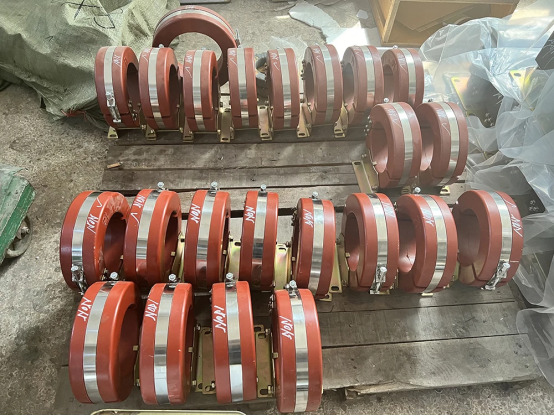
A current transformer ratio that works on paper can still trip you up in the field. The trick is to stop treating the ratio as a nameplate afterthought and start treating it as part of a loop: relay burden, lead resistance, maximum fault current, and the actual load you expect day to day. If any one of those drifts, a “standard” ratio can push the relay into saturation or leave it under-responsive.
Think of it as a balancing act, not a lookup table. You want the CT to stay linear through the worst-case through-fault, but you also need enough secondary current at normal load for the relay to read cleanly. That often means choosing a ratio that looks slightly too high on paper, then verifying the knee-point voltage and total connected burden before you bolt anything down.
The practical route is simple: pull the actual maximum fault level at the CT location, add the relay and wiring burden, then check the saturation voltage with a healthy margin. Compare that against the CT excitation curve. Once you see the numbers together, the right ratio stops being a guess and becomes the only ratio that fits.
Accuracy Is Not Optional: How Class and Burden Shape Performance
Accuracy is rarely treated as a negotiable goal in model development, yet real-world deployments quickly reveal that class distributions and resource constraints force hard choices between precision and practicality. Models optimized without these pressures often look impressive on benchmark splits but collapse under the messy conditions of production data, where rare events matter and compute is finite.
Class imbalance is one of the most persistent traps. When a minority class appears in only a fraction of training samples, a model can learn to blanket everything with the majority label while still reporting a deceptively high overall accuracy. This destroys the ability to catch critical anomalies, fraud, or rare failures—exactly the cases where mistakes carry the steepest cost. Chasing a single aggregate number systematically undervalues minority-class performance.
Burden shapes performance just as deeply. Computational budgets, labeling expenses, and latency ceilings impose hard ceilings on model complexity, forcing practitioners to choose between deeper architectures and faster inference. Under such constraints, accuracy cannot be bought with more parameters alone; it has to be engineered through smarter sampling, asymmetric loss functions, or lightweight designs that respect the true cost of error. Only by accounting for how class and burden interact does accuracy stop being a slogan and become a measurable, achievable target.
Clearance, Cores, and Cable Runs: The Physical Side of Getting It Right
Clearance isn't just about meeting code minimums. In cramped telecom closets, leaving enough room behind racks for punch-down tools and cable dressing can mean the difference between a 20-minute MAC work and a full afternoon of frustration. I usually aim for at least 36 inches of front clearance and 24 inches in the rear, but when you're dealing with deep switches and vertical cable managers, add another 6 inches or you'll be cursing every time you need to reseat a blade.
Cores get overlooked until you're trying to pull a bundle through a fire-rated wall. The hole size should account for the actual outside diameter of the cables, not the conductor gauge, and don't forget the bushing or sleeve. A ragged core will chew through a jacket in months. For larger bundles, use a 4-inch core minimum and keep the fill ratio under 40% so you can actually add that one extra drop later without tearing out drywall.
Cable runs live or die by support. Sagging runs aren't just ugly; they put tension on connectors and make tracing a nightmare. Space J-hooks every 4 to 5 feet for Cat6 and every 3 feet for high-flex applications, and use Velcro instead of zip ties. Tight zip ties deform the twist rate and can push alien crosstalk up—hard to diagnose after the ceiling grid is back in place.
Where These Transformers Do Their Best Work: Real-World Application Notes
In legal tech and healthcare administration, transformers earn their keep by reading through dense, unstructured text—contract clauses, patient notes, insurance claims—and flagging inconsistencies or missing details that a keyword-based system would skip. Their real advantage shows up when a decision depends on how a sentence in one section relates to a term defined three pages earlier. Teams often fine-tune a pretrained model on a few thousand labeled examples, then deploy it as a triage layer that highlights only the cases needing human review.
Outside of text, the same architecture lands well in visual inspection tasks. For instance, semiconductor fabs use vision transformers to spot microscopic wafer defects that blend into background patterns, while agricultural drones rely on them to separate crop stress from natural leaf variation across wide fields. In these settings, the model's ability to weigh every patch of an image against the whole scene cuts down on false alarms that a sliding-window CNN would raise.
That said, they are not a one-size-fits-all fix. Time series forecasting on short, noisy sensor streams often still favors simpler recurrent or statistical models. Where transformers do best is when the input has long-range dependencies and the cost of missing a subtle connection is high—think fraud detection across multi-hop transaction graphs or drug interaction screening that links molecular structure to clinical literature. The practical note is to validate against your own domain's failure modes, not just public benchmarks.
Buying Mistakes That Show Up as Midnight Alarms and How to Avoid Them
A few weeks after moving in, the first 2 a.m. shriek from the basement flooded your chest with dread. That bargain-priced water heater, installed by a handyman who quoted half the licensed rate, turned out to have a corroded pressure valve. Now every drip echoes like a countdown to a flooded floor. The real cost wasn't the unit or the labor—it was the sleep lost to a problem a proper inspection would have flagged in ten minutes.
The same pattern shows up in impulse buys at estate sales: a vintage light fixture that looked charming under the auction tent now flickers and hums because the wiring predates modern safety codes. You saved money on the fixture but spent triple on an emergency electrician to rewire the junction box. The lesson isn't to avoid old homes or secondhand finds—it's to treat every purchase as a system, not an isolated score. Ask what could fail at night, then budget for that answer.
To avoid these midnight alarms, slow down before you sign. Get written quotes that include disposal of old equipment, pull permits for anything touching gas, water, or electricity, and test appliances under load before the return window closes. If a deal depends on ignoring red flags, the discount is just a down payment on future panic.
FAQ
It measures the vector sum of current flowing through all conductors that pass through its window. When the system is balanced, the magnetic fields cancel and the secondary output stays near zero. Any current leaking to ground creates an imbalance, and that difference shows up as a measurable secondary current.
The window has to fit every phase conductor, and the neutral if it is present, without forcing or folding cables. Measure the outside diameter of the largest cable group and add about 15 percent clearance. A larger window makes installation easier but can reduce sensitivity at very low fault settings, so don't oversize without checking the minimum detectable primary current.
Start with the primary current range, turns ratio, and secondary output at the expected ground-fault level. Then check burden capability, accuracy class such as 5P10 or 10P10, and thermal withstand. The relay input range matters just as much as the transformer rating.
It can, especially in crowded switchgear or near drives and high-current buswork. A shielded zero-sequence transformer rejects external magnetic fields that would otherwise couple into the secondary winding and cause nuisance trips. Look for a continuous electrostatic shield with a dedicated ground lead.
The core determines how well the transformer resolves small leakage currents before saturation. High-permeability materials like nanocrystalline or nickel-iron alloys give good low-current sensitivity, while silicon steel may handle heavy through-fault currents more gracefully. Pick the core based on the smallest ground-fault current you need to detect and the largest possible fault current the unit may see.
Not reliably. Standard CTs are designed for one primary conductor and do not have the same winding balance or shielding for summing multiple phases. Using one can produce a residual signal even under normal load, which leads to false trips or missed faults.
If the neutral carries load current, it must pass through the same window as the phase conductors. Leaving the neutral outside creates an artificial residual current during normal unbalanced loading. All conductors should enter from the same side and follow the same direction marking.
Use a primary injection test with a low-level simulated ground fault and measure the secondary current at the relay terminals. Verify the relay picks up at the intended threshold and drops out when the fault clears. Also double-check polarity and make sure no shield lead or grounding conductor creates an alternate path through the window.
Conclusion
Choosing a zero-sequence transformer starts with recognizing that it is not simply another current transformer bolted into the same panel. A conventional CT reports phase current, but a zero-sequence unit looks at the vector sum of all live conductors passing through its window — normally zero in a balanced system. Any residual current tells the relay that something is leaking to ground. That difference changes how you size and apply the device. Matching the ratio to the protective relay is the first place where projects go sideways: pick too high a ratio and low-level ground faults stay hidden; pick too low and the relay may saturate on a heavy fault. Accuracy class and burden are inseparable from that decision because a relay needs enough driving voltage at the fault current you care about, not just at nameplate rating.
The physical installation often decides whether the scheme works in the real world. Core size must accommodate all phase conductors plus any neutral, with enough clearance for bending space, and the cable run to the relay should be short and shielded to avoid noise on the residual signal. These transformers earn their keep in resistance-grounded systems, generator protection, and anywhere a sensitive earth-fault element is required. The most common buying mistakes — undersized windows, mismatched ratios, or ignoring burden at low current — tend to surface as nuisance trips or, worse, a failure to trip when it matters. Spend the extra time on the nameplate details and the installation layout, and the zero-sequence transformer will do its quiet job without drama.
Contact Us
Contact Person: Doreen
Email: [email protected]
Tel/WhatsApp: 8618057712366
Website: https://www.liugaopower.com/