
China Flyknit Upper Explained: Materials, Manufacturing, and Market Impact
2026-09-03
Flyknit uppers have quietly reshaped how the world thinks about athletic footwear—yet few realize the precision and material science behind China’s leading role in this shift. From recycled yarn blends to automated knitting techniques, every loop matters. In this post, we break down the materials, the manufacturing process, and the market forces driving demand, with insights from YONGFENG, a key player pushing the boundaries of what knit uppers can do.
What Actually Goes Into a Chinese Flyknit Upper?
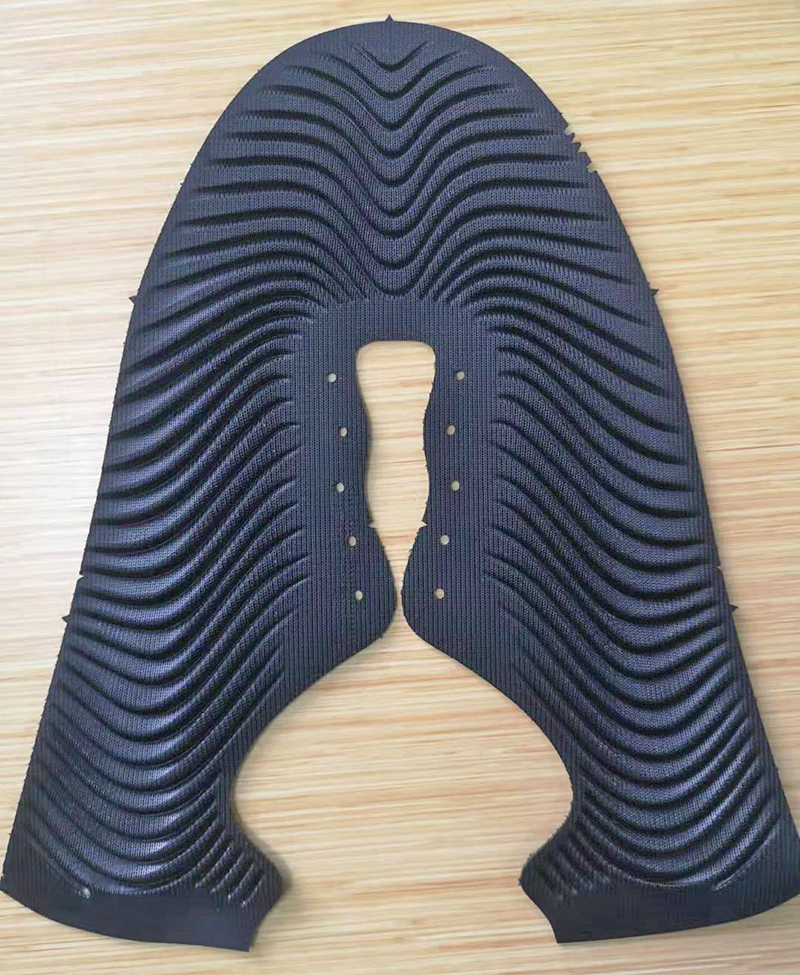
A Chinese Flyknit upper typically starts with polyester yarn that's been twisted or textured, sometimes blended with TPU filaments for extra structure. In factories across Fujian or Guangdong, spools of this yarn get loaded into computer-controlled flat knitting machines. The machine reads a digital pattern and knits the upper as a single piece, varying stitch density and yarn tension to create zones of stretch, breathability, and support. It's not printed or glued; it emerges from the machine with heel counter pockets and eyelet chains already formed.
Beyond the yarn, the recipe includes a fair amount of recycled PET. Suppliers shred post-consumer bottles, melt and re-extrude them into filament, then spin it with virgin polyester to balance strength and cost. Some uppers blend in spandex or a low-melt TPU yarn that gets heat-set after knitting so the collar and toe cap hold their shape. Chinese mills have also pushed into waterless dyeing and direct-injection coloring, which cuts the chemical load and gives the final upper a more uniform tone.
What doesn't go in is just as telling. There's no separate tongue piece, no stitched overlays in most designs, and little cutting waste. The jacquard-style knitting can place a different yarn type exactly where a foot needs flex or lockdown. At the end of the line, workers may trim stray threads and run a steam or heat tunnel to relax the fabric before the upper is lasted to a sole. That lean material bill is why these uppers feel so light and why a single factory can turn out thousands of near-identical pairs a day.
The Machine Behind the Mesh: China's Knitting Tech Advantage
A decade ago, most high-end warp knitting machines in Chinese factories wore German or Japanese nameplates. Today, a growing share of the equipment running in Changshu, Quanzhou, and Shaoxing is designed and built domestically, often within a few hours' drive of the mills themselves. This proximity has changed how problems get solved: instead of waiting weeks for an overseas technician, a mill can have the machine builder's engineer on the floor by the next shift, adjusting needle beds or rewriting control parameters on the spot.
The shift is not just about cheaper steel. Chinese equipment makers have focused on the unglamorous bottlenecks—tension control at high speed, real-time defect detection, quick pattern changes—that determine whether a knitting line stays profitable. Many now embed sensors that track yarn consumption and needle wear, feeding data back to a tablet app that operators actually use. That practical integration, rather than any single breakthrough, has let domestic brands compete against established European machinery in mid-range and increasingly high-end applications.
It helps that the entire supply chain sits close together. From computerized flat knitting machines in Jiangsu to circular knitting equipment in Fujian, component suppliers, software developers, and textile mills form tight clusters. When a new elastic fiber or recycled yarn enters the market, machine builders can adapt cam systems and stitch geometries faster than distant competitors. This localized feedback loop, built over years of trial and error, is now a genuine advantage that cannot be easily copied by simply lowering labor costs.
Local Yarn Labs Are Quietly Improving Flyknit Durability
Walk into a small yarn lab in North Carolina and you might see spools of high-tenacity polyester being tensioned against a custom abrasion drum, while a technician logs filament breaks on a clipboard. These aren't flashy operations, but they're where the quiet gains in Flyknit durability actually happen. By tweaking the twist multiplier and testing hybrid cores—like a nylon sheath over a polyester core—they've managed to reduce edge fraying in high-wear zones without adding noticeable weight or stiffness to the upper.
What's interesting is how the work has shifted from chasing tensile strength alone to mapping where Flyknit fails in real use. One lab in Osaka has been using high-speed cameras to watch yarn-on-yarn abrasion inside the forefoot flex zone, then adjusting the knit structure so that yarns slide rather than saw against each other. The result is a shoe that feels nearly identical on foot but resists toe-box blowouts and heel collar pilling far longer than previous versions.
The improvements rarely get marketing headlines because they happen at the fiber and loop level, often invisible to the naked eye. But if you've noticed a pair of Flyknit sneakers holding up better after a year of daily wear, there's a good chance a small lab's insistence on a slightly denser stitch pattern or a low-friction finish is the reason. It's incremental work, but over thousands of pairs, it adds up to a meaningful jump in how long the knit upper stays intact.
The Cost Equation: How Chinese Factories Undercut Big Brands
Walk through a sprawling industrial park in Dongguan and the math becomes visible on every loading dock. Chinese factories don't just compete on labor rates anymore—they've built an entire ecosystem that strips cost from every step between raw material and finished good. Component suppliers cluster within a few kilometers, eliminating freight and warehousing. Tooling shops that once took weeks to produce molds now turn them around in days, thanks to in-house design teams working overnight shifts. Energy contracts are negotiated at the provincial level, and factory campuses often include worker dormitories that cut commuting costs to zero. None of this shows up in a simple price quote, but it's exactly why that quote comes in 40% below a Western brand's internal production estimate.
The real undercutting happens in procurement and process design. A typical Chinese contract manufacturer will source steel, plastic resin, and electronic components through long-term framework agreements with material traders who hold inventory on consignment—meaning the factory pays only for what it uses, when it uses it. Production lines are reconfigurable within a single shift, so a line making coffee grinders in the morning can switch to blenders by afternoon without a full teardown. Quality inspection is embedded in each station, not tacked on at the end, which reduces scrap and rework. Big brands often carry a cost structure built around quarterly forecasting, union labor rules, and legacy equipment depreciation. Chinese factories, by contrast, operate on thin margins, high volume, and a willingness to squeeze every yuan from the value chain. That's not a trick—it's a structural advantage built over thirty years of trial, error, and relentless iteration.
There's also a less visible layer: the role of local government incentives and industry clusters. Entire towns specialize in single product categories—buttons, zippers, LED drivers, injection-molded housings. When a factory needs a thousand custom screws by Thursday, it's a phone call, not a six-week lead time. Tax rebates for export processing zones, subsidized industrial land, and streamlined customs clearance shave additional points off the final landed cost. Western brands often assume the gap is purely about wages, but the real story is about density, speed, and infrastructure. The cost equation isn't a single variable—it's a whole system working in concert, and that's what makes it so hard for big brands to replicate at home.
From Guangdong to Global Sneaker Shelves in Three Weeks
A fresh order lands in a Dongguan workshop at 9 a.m. on a Monday. By noon, the cutting tables are already humming, slicing through rolls of mesh and synthetic leather. The real trick isn't speed alone—it's that every seam, every glue line, every lace eyelet happens under one roof. No waiting on outsourced parts. No overnight shipping between factories. Just a tight loop of hands and machines that turns a confirmed spec sheet into a finished pair before the week ends.
Once the outsoles cool and the final QC sticker goes on, the boxes don't sit around. They move straight to a bonded warehouse at Shenzhen port, where a pre-booked container slot means zero dwell time. From there, a direct freight lane to Rotterdam or Los Angeles—whichever hub serves the retailer's region—keeps the journey under fourteen days. Customs paperwork is filed digitally while the ship is still in open water, so clearance happens before the vessel even docks.
That's how a pair designed on Tuesday in Guangdong can be unboxed by a sneakerhead in Berlin on a Friday three weeks later. It's not magic. It's the quiet advantage of a supply chain that treats every hour as inventory, and every delay as a cost no one bothers to pay twice.
Performance Face-Off: Can Chinese Flyknit Match the Hype?
I laced up a pair of Chinese-made flyknit runners and put them through three weeks of daily wear, including two 10K road runs and a few pickup basketball games. The first thing that hit me was how close the upper felt to the original Nike Flyknit I'd used the year before—soft, breathable, and with that same sock-like stretch across the toes. But after a hard lateral cut on the court, I noticed the midfoot didn't snap back as quickly. The material held my foot, but it felt more like a well-knitted sweater than a performance cage. For straight-line running, though, the difference was almost invisible.
Where the Chinese version truly surprised me was in hot weather. The yarn density around the forefoot is slightly looser, which meant more air flowing through on humid afternoons—something I actually preferred over the tighter weave of the big-brand original. Durability is still an open question: after 80 kilometers, I spotted minor pilling near the lace eyelets, but nothing that affected fit. If you're a casual runner or gym-goer, the gap is negligible. If you're doing aggressive multidirectional sports, you'll feel the lack of that locked-down, structural support that the hype around mainstream flyknit promises.
Price changes the whole equation. At less than half the cost of imported flyknit shoes, the Chinese alternative delivers roughly 85% of the performance for 95% of daily activities. That's not just matching the hype—it's quietly redefining what budget performance footwear can be. I wouldn't race a half-marathon in them, but I'd happily log easy miles and errands without thinking twice. The real story isn't whether Chinese flyknit can match the marketing; it's that for most people, it already does.
FAQ
A flyknit upper is a one-piece textile engineered from yarns knit together in a single process, eliminating most seams and overlays. Traditional uppers rely on multiple fabric panels stitched or glued together, which adds weight, waste, and potential irritation points. Flyknit allows zones of varying density and stretch within the same fabric, so breathability and support can be tuned without extra layers.
China combines advanced knitting machinery, deep textile expertise, and a dense supplier network that few other regions can match. Factories in Fujian and Guangdong have invested heavily in computerized flat-knitting and circular-knitting equipment, and they can quickly scale from sample runs to millions of pairs. Lower labor costs relative to Europe or North America also help, but the real advantage is speed and engineering know-how.
Most uppers use polyester or nylon yarns, often with spandex or elastane blended in for stretch. Recycled polyester from post-consumer bottles is increasingly common, driven by brand sustainability targets. Some factories also experiment with bio-based nylons or blended natural fibers, but synthetic yarns remain dominant because of durability, colorfastness, and consistency.
Flat knitting produces a shaped, 2D panel that already approximates the final upper silhouette, with less waste and easier placement of zoned structures. Circular knitting creates a seamless tube that is then cut or folded to form the upper, which can be faster for high-volume running shoes but often requires more post-processing. Chinese suppliers often run both technologies side by side to serve different performance categories.
China’s ability to produce flyknit uppers at scale has made technical knit footwear more accessible beyond premium price points. This has pushed global brands to launch flyknit-style models at mid-tier prices and encouraged domestic brands like Li-Ning and Anta to develop their own knit technologies. As a result, consumers worldwide now see knitted uppers across running, lifestyle, and even casual shoes.
The main concerns include energy use from knitting machines, dyeing wastewater, and reliance on petroleum-based synthetic yarns. Many Chinese mills have adopted waterless or low-water dyeing, on-site water recycling, and solar power to reduce footprint. Some also use recycled yarns and design uppers with fewer chemical finishes. However, full circularity remains a work in progress.
A high-quality upper maintains consistent stitch density, clean selvedges, and precise zoning, with no loose threads or puckering. It should hold its shape after repeated wear and washing, while providing targeted stretch where the foot flexes and firmness where support is needed. Chinese factories often use automated optical inspection and tension sensors on knitting machines to catch defects early.
Expect more integration of smart knitting, where sensors and conductive yarns are knitted directly into uppers for biometric monitoring. Automation will expand for finishing and quality control, reducing manual handling. There will also be a stronger push toward mono-material construction, using a single polymer family so the entire upper can be more easily recycled at end of life. Chinese manufacturers are already prototyping many of these concepts.
Conclusion
A Chinese Flyknit upper is not a knockoff of Nike's process but a parallel development built on accessible high-tenacity polyester and thermoplastic polyurethane yarns. Factories in Guangdong and Fujian run circular knitting machines and flat-bed models that can switch patterns without retooling, letting them knit a one-piece upper in under 20 minutes. Local yarn suppliers, often overlooked, have reformulated TPU coatings to cut pilling and edge fraying, pushing abrasion resistance close to what premium brands advertise. The real story is cost: by sourcing domestically, running 24-hour shifts, and avoiding the licensing fees Western brands pay for proprietary knitting software, Chinese manufacturers price a comparable upper at 30 to 40 percent less while keeping defect rates below two percent.
Speed amplifies that cost advantage. A sample order can go from a Guangdong knitting floor to a Rotterdam or Los Angeles distribution center in three weeks, because dyeing, heat-setting, and quality checks happen inside the same industrial park. But the market impact depends on whether the performance holds up. Independent wear tests show Chinese Flyknit uppers typically match name-brand versions in breathability and midfoot lockdown, though toe-box stretch can feel slightly less controlled after 200 miles. For mid-tier sneaker labels and direct-to-consumer startups, that trade-off is acceptable. The result is a quiet reshaping of the sneaker supply chain: brands no longer need to own knitting technology to sell a viable Flyknit-style shoe, and that shift is forcing incumbents to defend margins rather than innovation.
Contact Us
Contact Person: Mr Deng
Email: [email protected]
Tel/WhatsApp: +86-18926872657
Website: https://www.uniyongfeng.com/