
China Gold Plating Production Line: Advanced Solutions for Precision Finishing
2026-09-06
Precision finishing demands more than just a shiny surface—it requires engineering that balances conductivity, corrosion resistance, and flawless adhesion. As industries from electronics to aerospace push for tighter tolerances, China's gold plating production lines have evolved into hubs of innovation. Among the names driving this transformation, Junda stands out with advanced solutions that turn complex requirements into consistent, production-ready results. This blog peels back the layers of modern gold plating technology, exploring how Junda's approach redefines what precision finishing can achieve. Whether you're scaling up micro-connectors or safeguarding mission-critical components, the following insights will show you why China's plating expertise—anchored by Junda's engineering—is reshaping global standards.
Uniform Gold Thickness Control on Complex Part Geometries
Getting a consistent gold layer across intricate surfaces is rarely straightforward. Corners, recesses, and high-aspect-ratio features all pull current differently, and without careful management you end up with thicker plating on edges while shadowed areas stay starved. The usual fix involves a mix of custom fixturing, auxiliary anodes, and non-conductive shields that redirect current density where it's actually needed.
Pulse plating adds another layer of control. By cycling the current instead of running it flat, you give gold ions time to redistribute into tight cavities before the next deposition burst. This reduces the tendency for dog-boning at sharp edges and helps level out the thickness even on parts with sudden geometry changes. Bath agitation and temperature stability matter just as much—if the electrolyte doesn't move consistently through recesses, no amount of electrical tweaking will save the uniformity.
For truly complex shapes, simulation-driven tooling design has become the practical route. Mapping the current distribution before cutting metal lets you place thieves and shields with intent, not guesswork. The result is a process that holds thickness within a few microinches across the entire part, which is what downstream bonding or soldering steps actually demand.
Modular Tank Layouts for Fast Product Changeover
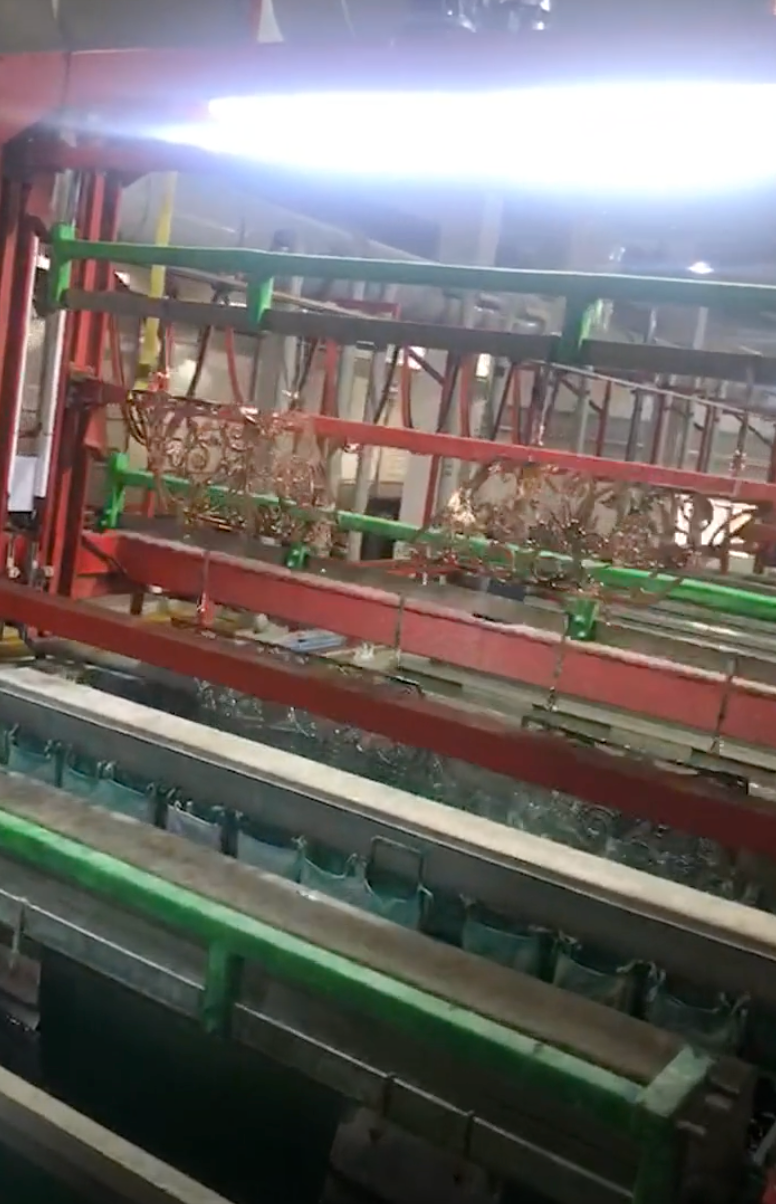
Instead of hard-piping tanks into fixed positions, modular tank layouts use a grid of utility stations and standardized connection points so vessels can be rolled in or out without cutting pipe. Each tank sits on a frame with matched nozzle heights, and manifolds for CIP, product, and drain lines run overhead or in a trench. Changing over means disconnecting a few camlock or DIN fittings, moving the tank, and reconnecting to the same port pattern. That avoids re-validation of line routing and cuts the time spent reconfiguring from days to a single shift.
The layout works best when every module shares the same interface: supply, return, vent, and drain positions are identical across sizes. Some plants add a dummy block or blind plate on unused manifold branches to eliminate dead legs and cross-contamination risk. Labeled quick-connect panels and color-coded hoses help operators make the switch without consulting a piping diagram. Because the floor plan doesn't change between products, cleaning and batch records stay consistent.
Automated Chemical Monitoring That Extends Bath Service Life
Maintaining bath chemistry over extended production runs often feels like a guessing game. Rather than relying on periodic manual sampling, automated monitoring continuously tracks key parameters such as pH, metal concentration, and additive levels. This real-time data stream catches subtle shifts long before they cause visible defects, letting operators make small corrections instead of waiting for a costly failure.
The main payoff is a longer, more predictable service life for the plating bath. By preventing contaminant spikes and maintaining additive balance within narrow windows, the system reduces the frequency of full bath dumps and recharges. It also cuts down on rework from inconsistent coating quality, since variations are flagged and addressed while still within acceptable limits.
Beyond just extending bath life, automated monitoring changes how maintenance is scheduled. Instead of reacting to problems, technicians can plan targeted replenishments based on actual bath usage patterns. This shift away from fixed-interval replacements saves both chemicals and downtime, while keeping the process closer to its optimal operating range for more of each working day.
Low-Ripple Rectifiers and Energy-Efficient Heating
A well-filtered DC bus changes how heating elements behave under load. Instead of pulsing with significant voltage ripple, nichrome or silicon carbide elements receive a nearly flat supply, which reduces cyclic thermal expansion and keeps resistance values stable over longer runs.
In process heating, the advantage shows up as tighter control over surface temperature. Ripple-induced hot spots force controllers to overcompensate, wasting energy through overshoot and uneven heat distribution. With low-ripple rectification, the feedback loop sees less noise and can hold a setpoint within a few degrees without constant switching.
Equipment lifetimes also improve because insulation and connectors are not stressed by repeated peak currents. A lower ripple factor means capacitors and magnetic components run cooler, which cuts parasitic losses. The overall result is a heating system that draws fewer kilowatt-hours for the same thermal output, especially in continuous-duty applications like ovens, furnaces, and pipe tracing.
Inline Non-Destructive Testing for Zero-Defect Finishing
Achieving zero-defect finishing in manufacturing demands more than end-of-line sampling. The real shift happens when inspection moves directly into the production flow, catching surface flaws the moment they form. Instead of waiting for a batch to complete, sensors embedded along the finishing line continuously scan for pits, scratches, or coating inconsistencies. This immediate feedback lets operators adjust polishing pressure, change abrasive belts, or tweak spray parameters before a single defective part reaches the next stage.
What makes inline non-destructive testing stand out is its ability to see what the human eye misses at production speed. Laser profilometry, eddy current sensors, and high-speed machine vision work together to map surface topology without ever touching the workpiece. The data isn't just a pass/fail signal — it reveals subtle drift in tool wear or bath chemistry. By the time a threshold is crossed, the system has already flagged the root cause, not just the symptom.
For finishing lines that once relied on random audits, this approach closes the gap between inspection and action. Every part gets verified, yet none are slowed down or damaged. The result is a finishing process that doesn't just find defects after they happen, but actively prevents them from becoming defects at all.
Turnkey Lines with Pre-Treatment and Wastewater Recovery
Our skid-mounted turnkey lines combine pre-treatment, reverse osmosis, and wastewater recovery in a single control loop, so operators can switch from raw intake to brine polishing without reworking pipe runs. Each train is hydraulically balanced at the factory and arrives with pre-commissioned instrumentation, which cuts site wiring and startup time by roughly half compared to stick-built systems.
The pre-treatment stage uses self-cleaning disc filters followed by ultrafiltration membranes rated for turbidity spikes up to 300 NTU, protecting downstream RO elements from fouling during storm events or upstream process upsets. Reject from the RO passes through a recovery stage where a second low-pressure membrane array reclaims up to 85% of the concentrate, leaving only a small volume of supersaturated brine for off-site disposal or evaporative finishing.
Panel builders pre-wire every pump, valve, and analyzer to a common PLC with tag names matching the P&ID, so maintenance teams can trace a fault from the HMI to the terminal strip in minutes. Because the whole line is mounted on a coated steel base frame with lifting lugs, it can be set on a slab, connected to four utility stubs, and producing spec water within a single shift.
FAQ
These systems combine programmable rectifiers, tight temperature control, and fine filtration to maintain deposit uniformity even on intricate parts. The tank layout and anode placement are engineered to reduce edge buildup, which matters a lot for connectors, contacts, and decorative hardware.
Electronics, jewelry, automotive, medical devices, and luxury packaging. In electronics, selective plating is often used for contact pads and pins; in jewelry and watches, the focus is more on consistent color and wear resistance.
Almost every section can be adjusted such as tank size, number of rinse stages, drying method, barrel or rack plating, and automation level. Some manufacturers also offer modular designs so additional tanks can be added later without a full rebuild.
Inline thickness testers, pH and temperature sensors, and automatic dosing help keep the bath within spec. Many lines include a dedicated lab area for regular Hull cell tests and adhesion checks before full production runs.
Programmable hoists or robotic arms handle transfer timing, dwell periods, and current ramping. Removing manual variation cuts down on missed rinses, uneven gold distribution, and contamination between tanks.
Check for in-house fabrication capability, previous installations for similar parts, and solid after-sales support including training and spare parts availability. A factory visit or a pilot plating test is usually worth the time.
Modern designs use counterflow rinses, insulated tanks, and heat recovery from dryer exhaust. Effluent treatment options can also recover gold from drag-out, which lowers both waste and operating cost.
Depending on complexity, most projects run from 10 to 16 weeks from design approval to installation. Custom automation, cleanroom integration, or special materials like PVDF tanks can extend that timeline.
Conclusion
China's gold plating production lines have evolved into precision-driven systems that tackle the toughest challenges in surface finishing. At the core is uniform thickness control on complex geometries, achieved through advanced anode shielding, conforming fixtures, and pulse plating algorithms that compensate for current density variations. This ensures consistent deposition even on deep recesses, sharp edges, or intricate connectors. Complementing this, modular tank layouts allow rapid product changeover—operators can reconfigure plating cells, rinse stations, and drying modules within minutes, slashing downtime and enabling small-batch runs without sacrificing throughput.
Beyond mechanics, automated chemical monitoring constantly samples bath chemistry and adjusts additives in real time, dramatically extending service life and reducing hazardous waste. Low-ripple rectifiers deliver stable DC output that prevents burning and improves adhesion, while energy-efficient heating systems cut power consumption by up to 30% compared to conventional immersion heaters. Inline non-destructive testing—using X-ray fluorescence and eddy current sensors—verifies coating thickness and porosity on every part before it leaves the line, effectively eliminating field failures. Finally, turnkey configurations integrate pre-treatment, plating, post-treatment, and closed-loop wastewater recovery, allowing manufacturers to meet strict environmental regulations while maintaining high yield. These lines represent a shift from manual artistry to data-driven, zero-defect finishing, giving Chinese equipment makers a competitive edge in electronics, automotive, and medical device markets.
Contact Us
Contact Person: hayyr
Email: [email protected]
Tel/WhatsApp: 8613082110525
Website: https://www.jundaelectroplating.com