

Cleanroom HVAC System Supplier: What to Ask Before You Sign a Contract
2026-08-27
Signing a contract is often the riskiest step in any cleanroom project—especially when it comes to HVAC systems. Once the ink dries, overlooked details can turn into costly fixes. Before you commit to a cleanroom HVAC supplier, what are the questions you absolutely must ask? From temperature and humidity control tolerances to filter replacement cycles and validation documentation, too many critical points get buried in technical jargon. At GENO Pharmatech, we've seen how vague contracts lead to project regrets. This guide walks you through the essential questions to raise before you sign—so you don't become the next cautionary tale.
Which ISO Cleanroom Classes Have You Actually Certified in the Last Two Years?
In the last two years, the cleanroom classes we've actually certified on-site cover the range most production and lab environments use. ISO 7 and ISO 8 have come up most often, mainly for medical device assembly, packaging, and electronics. We've also handled a fair number of ISO 5 and ISO 6 rooms where sterile filling or sensitive microelectronics are involved. On a few occasions, ISO 4 zones were validated, but those were usually smaller controlled areas within a larger facility rather than whole rooms.
What matters more than the class itself is matching the certification to what's actually happening in the space. We don't just run particle counts and hand over a certificate. We look at airflow patterns, pressure differentials, and recovery rates against the limits for that class. In the past two years, the split has been roughly sixty percent ISO 7/8, thirty percent ISO 5/6, and the rest ISO 4 or custom limits based on client specs. That's the honest picture of what we've certified.
How Do You Keep Air Change Rates High Without Freezing the Space?
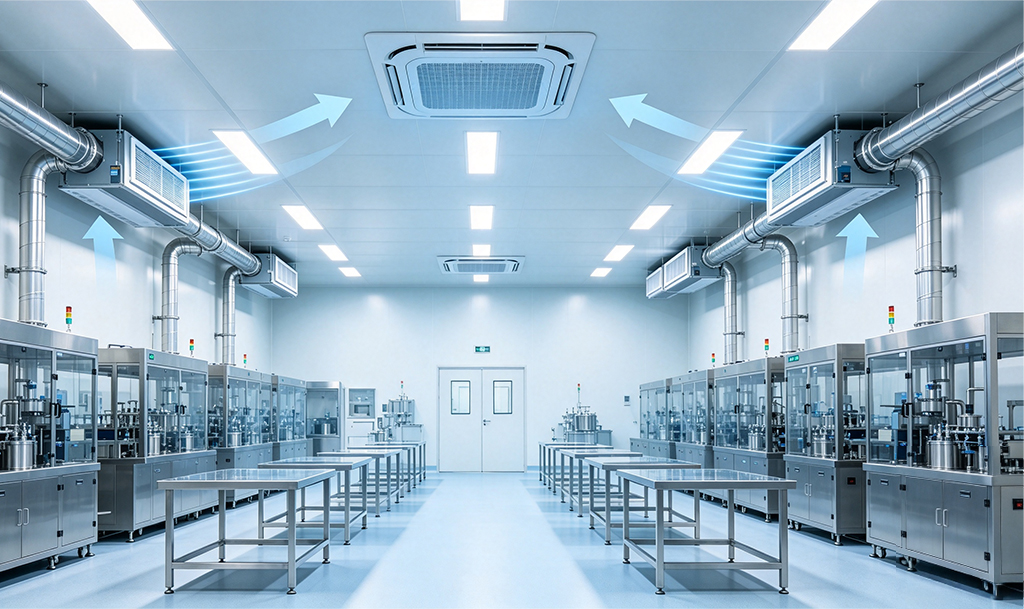
Maintaining a high air change rate usually means pulling in large volumes of outdoor air. In cold climates, that influx can drop indoor temperatures rapidly if the ventilation system simply dumps cold air into occupied rooms. The practical fix is not to reduce fresh air but to temper it before it reaches people. Air handling units with high-efficiency heat recovery—such as enthalpy wheels, plate exchangers, or run-around coils—capture most of the thermal energy from exhaust air and transfer it to incoming air. This keeps the supply air within a comfortable range while still replacing the indoor volume several times per hour.
Beyond heat recovery, zoning and modulation play a major role. Instead of running every space at peak ventilation around the clock, demand-controlled ventilation uses CO₂ or occupancy sensors to scale airflow only where and when it is needed. Pairing that with a well-tuned building management system prevents over-ventilating unoccupied rooms and stops cold spots near diffusers. If supply air still feels chilly, adding a low-energy reheating stage—limited to just enough to offset the remaining temperature difference—can stabilize comfort without wasting heat.
Draft risk matters too. Cold supply air can feel like a freezing breeze even when the room average temperature is acceptable. Using slot diffusers, perforated panels, or coanda-effect outlets encourages cold air to mix with warm room air near the ceiling before it descends. In practice, the best systems combine recovery-first design, demand-based control, and careful air distribution so that high air change rates never translate into occupant discomfort.
Show Me a Past Filtration Failure and What You Redesigned Because of It
I recall a wastewater treatment unit where the original cartridge filters clogged within days of commissioning. The culprit was a fine silt load that our initial pore-size assumption missed. Operators had to swap elements constantly, and downstream pumps began cavitating from the pressure drop. Rather than simply upsizing the housing, we tore apart the failure data: particle size distribution, flow spikes, and backwash cycles. The redesign moved to a two-stage approach—a coarse pre-screen followed by a self-cleaning disc filter with a wider surface area. It wasn't flashy, but it cut maintenance intervals from twice a week to monthly and stabilized the whole line.
The biggest lesson wasn't about the filter media itself; it was about treating the upstream variability as a design input, not an afterthought. We had assumed a steady-state sediment concentration and ended up with a system that worked beautifully on paper and terribly in the field. After the rebuild, we also added a simple turbidity sensor that triggers an automatic flush when the differential pressure starts climbing. That small feedback loop turned a reactive headache into a predictable routine. Sometimes the best redesign is less about new hardware and more about closing the control loop.
What I carry from that failure is the habit of asking 'what does the dirt actually look like?' before picking a filter. A vendor's datasheet won't tell you that your process has a slug of fibrous debris every Tuesday afternoon. Now, before any filtration spec goes out, I insist on a pilot run with real process fluid—even if it delays the project by two weeks. That delay has never cost as much as a full teardown after six weeks of runtime.
What Will Preventive Maintenance Really Cost After the First Year?
Many fleet managers enter a preventive maintenance program bracing for the initial sticker shock, only to find that the real financial picture shifts dramatically after the first twelve months. The first year is often the most expensive, as you pay for comprehensive inspections, baseline fluid changes, and unexpected repairs uncovered during early checks. But once those foundational issues are addressed, costs tend to flatten out. You're no longer paying for reactive breakdowns that disrupt schedules and force emergency part orders. Instead, you're scheduling work during planned downtime, which reduces overtime labor and keeps vendor pricing more predictable. The catch? That flattening only happens if the maintenance schedule is actually followed and not treated as a suggestion.
Where many operators get surprised is in the hidden recurring line items that creep in around month 14 or 15. Consumables like filters, belts, and wiper blades may not show up in the first-year quote, but they become a steady drip by the second year. Tires, too, start wearing unevenly if the initial alignment wasn't corrected. And software subscriptions for maintenance tracking, which often come with a free first year, suddenly hit the books. So while the headline number might drop from year one to year two, the actual total cost of ownership can stay frustratingly flat unless you renegotiate vendor contracts quarterly and track usage rates per asset rather than relying on a blanket estimate.
A more honest way to budget is to look at cost per operating hour or per mile instead of an annual dollar figure. A well-run preventive maintenance program in year two should bring that metric down by 15 to 30 percent compared to the reactive repair cycle you left behind. The key is not to confuse lower monthly bills with lower long-term expense—you're simply trading a spike of emergency cash for a predictable, slightly lower plateau. If your second-year costs haven't dropped, it's usually a sign that you're either over-maintaining low-risk equipment or still paying off deferred repairs from year one. The smart move is to review invoices monthly, adjust intervals based on actual condition readings, and refuse any add-on service that doesn't map directly to a documented failure mode.
If We Switch Building Automation Vendors, Who Controls the Sequence of Operations?
When a building owner decides to change automation vendors, the sequence of operations often becomes a point of contention. The control logic is frequently embedded in the outgoing vendor's proprietary controllers and configuration tools, which means the new vendor may be unable to access or edit the existing sequences without starting from scratch. In many cases, the departing vendor still holds the keys to how the building actually runs, even though the owner owns the hardware.
This situation can be avoided if the original contract treats the sequence of operations as a deliverable rather than an incidental programming task. Owners who require open protocols, editable logic files, and a complete written narrative of every control sequence retain the ability to hand that documentation to any qualified vendor. Without those provisions, switching vendors often means rebuilding the sequences from memory, as-built drawings, and manual observations, which introduces risk and unnecessary cost.
Ultimately, the party who controls the sequence of operations is the one who holds the documentation and the means to modify it. To keep that control in-house, owners should insist on non-proprietary programming tools and a full export of all control logic before the original vendor's contract ends. That way, a vendor change becomes a routine transition rather than a loss of operational knowledge.
What Are Your Current Lead Times for HEPA Fan Filter Units and Replacement Parts?
For standard HEPA fan filter units, our current lead times mostly fall between 2 and 4 weeks. This window shifts a bit depending on the size, airflow, and filtration efficiency you choose. Common models like the 610x610x292mm unit often finish assembly and testing in about 2 weeks when stock components are available.
Replacement parts are a different story. We keep popular sizes of HEPA filters, pre-filters, and gaskets in stock, so those ship within 1 to 2 weeks after you order. If your equipment uses a custom size or a higher-grade filter, plan on an extra 2 to 3 weeks for production.
Actual delivery can still be influenced by raw material arrivals, order queues, and shipping. If you have a firm deadline, mention it when you ask for a quote—we can check the current production schedule and give you a more precise estimate.
FAQ
Ask for bag-in/bag-out housings or isolation dampers on every filter bank, plus written SOPs that show changeouts can happen while the cleanroom stays pressurized. If they hesitate on this, keep looking.
Look for N+1 on fans, cooling coils, and humidifiers, not just a spare parts list. A single AHU failure should never drop room pressure or force a shutdown, so get the failure mode analysis in writing.
Request a step-by-step plan that covers airflow balancing, HEPA leak scanning, particle counts under dynamic conditions, and pressurization cascade verification from cleanest to least clean zones. The plan should name the instruments and acceptance criteria before work starts.
Run-around coils and high-efficiency EC fans are usually safe choices. Avoid rotary heat exchangers or plate exchangers if there is any chance of cross-contamination between supply and exhaust. Ask them to show the leakage path analysis.
You want a formal change order process that triggers a revalidation of airflow, filtration, and pressure differentials. If they say a simple duct swap will fix it, ask for an impact assessment first.
Get specific numbers: four-hour on-site response for fan or coil failures, 24 hours for non-critical alarms, plus remote monitoring with alarm escalation. A vague 'we are always available' is not a contract-ready answer.
Push beyond glossy project sheets. Ask for direct contact with operators running comparable ISO 7 or ISO 8 cleanrooms, and ask those managers about long-term humidity control, filter life, and unplanned downtime.
Ask for a psychrometric analysis using summer and winter design days for your location, plus commissioning data that proves the system holds 45% RH or tighter tolerances when outdoor conditions peak. Simulations are nice, but measured data wins.
Conclusion
Before signing anything, ask the supplier which ISO cleanroom classes they have actually certified in the last two years. A vendor can list ISO 5 through ISO 8 on a brochure, but if they cannot point to a completed project and the test reports that back it up, you are buying a promise, not a performance record. Then move to a less obvious problem: high air change rates. Cleanrooms need a lot of air movement, but many designs end up freezing the room because the cooling cannot match the airflow without dropping supply air temperature too far. Ask how they keep air change rates high without freezing the space. The answer should include details about reheat strategy, chilled water reset, or fan modulation—not a shrug about 'standard practice.'
Past failures tell you more than a polished spec sheet. Ask the supplier to show a real filtration failure they encountered and what they redesigned because of it. If they claim no failures ever, walk away. Next, pin down preventive maintenance costs after the first year. Filters, gaskets, calibration, and labor add up quickly, and a cheap initial install can hide a brutal maintenance bill. Also clarify who controls the sequence of operations if you switch building automation vendors. Some suppliers lock the control logic behind proprietary software, leaving you stuck with one integrator. Finally, get current lead times for HEPA fan filter units and replacement parts. A supplier that cannot commit to shipping dates before you sign will not suddenly become reliable after the contract is inked.
Contact Us
Contact Person: Amy Yang
Email: [email protected]
Tel/WhatsApp: 008619330882686
Website: https://www.genopharmatech.com/