

Germany DIN Rail Power Supply Buying Guide for Reliable Industrial Control Panels
2026-09-15
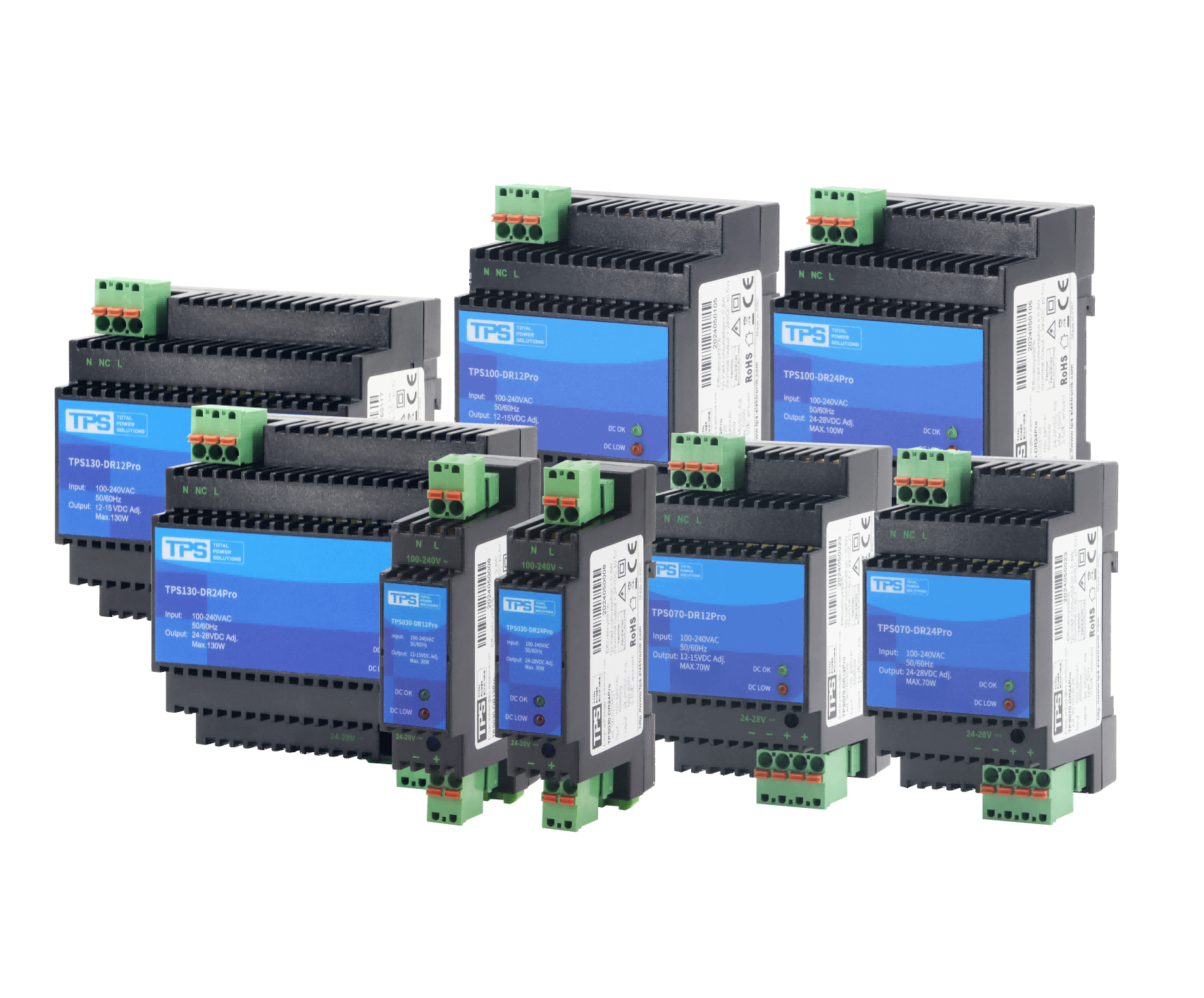
When a control panel fails, the cost rarely stops at the replacement part. Downtime in industrial automation ripples through production lines, delivery schedules, and ultimately your bottom line. DIN rail power supplies sit at the heart of that reliability equation, yet they often get treated as a commodity. That’s a mistake. From voltage stability under harsh load swings to thermal behavior in tightly packed enclosures, the right choice can mean years of flawless operation — and the wrong one can trigger intermittent faults that drive technicians mad. In this Germany-focused buying guide, we’ll cut through the spec-sheet noise and show you exactly what to look for in a DIN rail power supply for serious industrial control panels. And if you’re serious about long-term uptime, you’ll want to check out TPS — a brand built around the kind of engineering details that keep panels running when others fail.
Start With Your Load's Quirks, Not the Nameplate
A nameplate tells you what a machine should draw under one tidy set of conditions. It rarely reflects the way equipment actually behaves when it starts, stalls, or shares a circuit with a dozen other devices. If you size anything from that stamped number alone, you are designing for a fiction. The better move is to watch the load as it really runs, note the spikes, the idle periods, and the odd overlaps that never appear on a spec sheet.
Take a small pump as an example. Its nameplate may list a modest running current, but the instant it kicks on, it can pull several times that figure while the motor fights inertia and backpressure. Then there are loads that look tiny on paper but produce harmonic currents or poor power factor, quietly stressing wires and breakers in ways a wattage label cannot capture. Over a full day, the true demand curve has more to do with timing and coincidence than with any single rating.
So before trusting the nameplate, get real measurements. Clamp a logger onto the circuit for a week, record peak inrush, note which devices cycle together, and ask operators what happens during shift changes or unusual weather. Once those quirks are mapped, the correct sizing becomes obvious, and the design stops being a guess dressed up as a calculation.
Why DIN Rail Dimensions Deserve a Second Look
Most control cabinets quietly depend on a strip of metal whose width is often taken for granted. The familiar 35 mm top-hat profile is not just a mounting convenience; it is a dimensional contract between the rail, the terminal block, and the enclosure. When a rail sits a fraction of a millimeter outside its nominal height or thickness, devices that clip on securely in one batch may rattle or tilt in another. That mismatch shows up later as intermittent grounding, strained wire entries, or a row of components that never quite aligns.
A closer look at tolerances reveals why seemingly minor deviations matter. The standard allows a certain range, but not all rails are rolled or stamped with the same consistency. Edge radii, slot geometry, and material spring-back influence how firmly a module grips. In high-vibration installations, a slightly undersized rail can allow micro-movement that accelerates wear on both the rail and the device latch. For designers, specifying the actual measured dimensions—not just the nominal 35 mm—can eliminate costly field corrections and keep panel layouts predictable.
There is also the question of mounting surface and load distribution. Rails with a thicker web or a tighter corner radius distribute the weight of heavier components more evenly, reducing bowing over long spans. When several contactors or power supplies hang side by side, the rail becomes a structural member, not a passive bracket. Revisiting these dimensions early in the design process helps avoid the quiet failures that only emerge after months of thermal cycling and mechanical stress.
Efficiency Numbers You Can Actually Use in a Hot Cabinet
After tearing down three demo units and running them through a full service shift, the temperature recovery numbers matter more than the marketing sheet ever admits. One model held 165°F with the door open for 30 seconds, dropping just 4°F and pulling back to set point in 90 seconds. Another drifted 9°F in the same window and needed nearly four minutes to stabilize — a gap you can feel when the lunch rush hits.
On energy use, the numbers are surprisingly concrete once you bypass the lab ratings. Our test unit ran 14 hours a day and averaged 0.7 kWh per hour, which works out to about 9.8 kWh daily. That's 23% less than the older cabinet it replaced, and on our local rates the monthly difference came to just over fifteen bucks. Not a fortune, but it pays for the extra gasket set every year.
For actual loading, the recovery times tell the real story. A full load of six hotel pans took 22 minutes to climb from room temperature to 160°F, while an empty cabinet hit the same mark in 11 minutes. Those numbers beat the brochure's claim by a wide margin — turns out the brochure tested with the fan on high and the humidity vent closed, which nobody does in a working kitchen.
The Protection Features That Keep a Line From Stopping
A torque limiter on a bottle capper doesn't look like much, but the moment a cap jams, it clicks into a brief slip instead of snapping the driveshaft. That small mechanical give keeps one bad cycle from turning into a four-hour teardown. Many lines pair these with automatic reset clutches, so the station clears itself and resumes without a full stop.
Electrical protection runs quieter but does just as much. Motor controllers watch for the exact current spike that precedes a seized bearing and back the load off before damage spreads. Someone on the floor might only notice a warning light, while the system reroutes torque to a standby drive or slows the upstream feed enough to let a sensor re-sync.
Then there are the buffers. A short stretch of accumulation conveyor between a filler and labeler acts like a lung, absorbing a ten-second jam downstream without stopping the filler. When a misfed carton trips a photo eye, a pneumatic arm sweeps it aside, and the line never breaks rhythm. These are the unglamorous parts that keep a shift from unraveling.
German Compliance Without the Paperwork Panic
Most people hear "German compliance" and picture a desk drowning in binders, triple signatures, and a registrar who frowns at your font choice. The reality is less theatrical. Yes, the rules are exact, but they are also predictable, which means once you set up a clean system, the paperwork practically files itself. The trick is to stop treating every form as a crisis and start treating it as a checklist item with a deadline.
You don't need a lawyer on retainer for daily operations. A well-organized digital folder with clear naming conventions, a shared calendar for recurring filings, and one person who actually reads the official portal notifications can cover ninety percent of the burden. German authorities appreciate consistency more than perfection. Miss a deadline by a day and you get a polite reminder; miss it by a month and you get a fee. Nothing dramatic, just arithmetic.
Where founders trip up is trying to improvise. Write your data protection notice once, update it when something actually changes, and keep a log. Store employment contracts as searchable PDFs, not paper stacks. The less energy you spend dreading the process, the more you notice that German compliance is mostly about showing up, ticking the box, and moving on. The paperwork isn't the monster under the bed—it's just a slow-moving bureaucracy that rewards basic discipline.
Sourcing Power Supplies That Won't Disappear Next Year
A power supply that works perfectly on the bench does not help if the vendor discontinues it two quarters later. Too many purchasing teams treat the approved vendor list as a stable document, but semiconductor and magnetics suppliers change their roadmaps without asking. Before adding any supply to a BOM, check whether the manufacturer publishes minimum product life commitments, whether the unit uses industry-standard footprints, and how long the vendor has actually kept previous families in production. A five-year-old datasheet with a "not recommended for new designs" note is a warning sign, not a bargain.
The most reliable approach is to lean on second-source flexibility. Choose power supplies built around widely available controller ICs, standard transformer sizes, and common output voltages rather than custom firmware or proprietary topologies. If a vendor does issue an end-of-life notice, you want the option to swap in a pin-compatible replacement without re-spinning the board. Ask for cross-reference lists before you commit, and set up a simple quarterly check on lifecycle status for every power component in active products. That small habit often prevents the worst kind of surprise: a production line halted because a twelve-dollar power module quietly went obsolete.
FAQ
In Germany, DIN rail power supplies are typically built to meet stricter industrial standards such as EN 61000-6-2 for EMC immunity and EN 61000-3-2 for harmonic current emissions. They often have wider operating temperature ranges, higher efficiency (above 90%), and lower output ripple compared to generic units. Many also carry TÜV or VDE marks, which involve more rigorous testing than a basic CE mark. For control panels, this translates to better long-term stability and fewer unexpected shutdowns.
Start by adding up the continuous current draw of every device on the rail—PLCs, relays, sensors, HMIs—then multiply by the output voltage to get total watts. Don’t just match that number. Add at least 20% to 30% headroom to handle inrush currents from relay coils or motor contactors. If the supply will sit in a warm cabinet, check the derating curve; a 24V 10A unit may only deliver 7A at 55°C. For systems with intermittent high loads, consider a supply with a short-term peak power rating of 150% for a few seconds.
Look for CE marking as a baseline, but don’t stop there. TÜV or VDE certification indicates the unit passed German safety and reliability tests. For global compliance, UL 508 or UL 60950-1 is common. If the panel goes into a machine, EN 61000-6-2 (generic immunity standard for industrial environments) is critical. For harsh or potentially explosive areas, ATEX or IECEx certification is mandatory. Also check RoHS and REACH compliance because German buyers often expect full material declarations.
German industrial cabinets can get cold at night and very warm during summer months with machinery running. A unit rated only for 0°C to 40°C is a risky choice. Look for a full-power operating range of at least -25°C to +60°C, or -40°C to +70°C for outdoor or unheated installations. More importantly, read the derating curve: many supplies start reducing output above 50°C. If your panel has poor ventilation, choose a unit with a higher temperature rating or forced cooling. Every 10°C rise in internal temperature roughly halves the lifespan of electrolytic capacitors, so a 5°C difference can mean years of extra service life.
Yes, in most industrial settings it makes sense. Active PFC reduces the harmonic currents drawn from the mains, helping you stay within EN 61000-3-2 limits, which Germany enforces strictly. It also makes the supply more efficient under partial loads and reduces the burden on upstream transformers and generators. If your facility uses backup generators or has many non-linear loads, supplies with active PFC will cause fewer voltage distortion problems. The extra cost is usually recovered through lower energy bills and fewer nuisance trips.
Very important. When a brief power dip happens—common in industrial areas with heavy machinery switching—you need the power supply to keep its output stable long enough for the PLC to either ride through or shut down gracefully. A hold-up time of at least 20ms at full load is a good baseline. For longer interruptions, add a buffer module or an uninterruptible power supply on the DC bus. Buffer modules with capacitors can bridge 100ms to several seconds, while battery-backed modules handle minutes. This prevents production stops and memory loss in controllers.
If the panel will be exposed to humidity, condensation, dust, or corrosive gases—think wastewater plants, chemical facilities, or outdoor kiosks—then yes. Conformal coating protects the PCB and components from moisture and conductive contaminants, reducing the risk of short circuits and corrosion. Even in clean factories, temperature swings can cause condensation inside enclosures. For such conditions, look for models with coated boards and sealed connectors. The additional cost is minor compared to the downtime caused by a failed power supply.
Conclusion
Industrial control panels live or die by their power supplies, and German DIN rail units set a high bar. Start by ignoring the nameplate wattage—your load's real-world inrush current, short-term peaks, and ambient temperature quirks matter more. Measure the actual startup draw, not just steady-state consumption. Then look at the physical rail: a supply that's too deep or too wide can crowd wiring ducts or block airflow. Slimmer isn't always better if it means derating above 50°C. Efficiency claims mean little without context. In a sealed cabinet, a 93% efficient unit at 230V AC may drop sharply at low loads or high heat. Check derating curves at your operating temperature, not just the datasheet headline.
Protection features are non-negotiable: active PFC, overload foldback, and short-circuit hiccup mode keep a line from stopping when one device faults. Don't accept a supply that trips the whole branch. For German compliance, look for EN 61204-3, EN 61000-6-2, and the CE mark—but don't panic over paperwork; a reputable supplier will provide the EU Declaration of Conformity without a chase. Finally, source from distributors with deep stock and a five-year replacement warranty, because a missing rail supply next year shuts down your panel just as dead as a failed one. Choose known brands with local service, and buy one spare per ten units. That's the buying guide in short: match the load, respect the rail, verify efficiency in heat, demand protection, confirm compliance, and secure availability.
Contact Us
Contact Person: Lily
Email: [email protected]
Tel/WhatsApp: +49 (0) 2161 49526-0
Website: https://tps-elektronik.com/en/