

Professional Triisopropanolamine: Applications and Benefits in Industrial Chemistry
2026-07-15
Triisopropanolamine might not be a household name, but behind the scenes, this versatile amine plays a starring role in countless industrial processes—from enhancing cement grinding efficiency to stabilizing agrochemical formulations. At HAISEN, we’ve harnessed its unique properties to deliver high-purity solutions that boost productivity and sustainability for manufacturers worldwide. Curious how this unsung hero could optimize your operations? Let’s dive into its real-world applications and the benefits that set it apart.
The Hidden Chemistry Behind TIPA’s Multi-Functional Role
Triisopropanolamine (TIPA) might look like just another amine on paper, but its molecular architecture tells a more nuanced story. The three isopropanol groups attached to the central nitrogen create a sterically hindered environment that dramatically alters its reactivity compared to simpler amines. This hindrance isn’t a weakness—it’s the key to its versatility. In cement grinding aids, for instance, the bulky groups prevent excessive adsorption on certain clinker phases while still allowing strong interaction with others, leading to a balanced improvement in both early and late strength. This selective affinity is a direct result of the hidden chemistry at play, where spatial arrangement dictates which surfaces get coated and which reactions are accelerated or slowed.
Dig deeper, and you’ll find that TIPA’s dual role as a chelating agent and a pH regulator is rooted in the same electronic and geometric factors. The lone pair on the nitrogen isn’t entirely free—its accessibility is modulated by the surrounding alcohol branches. This means TIPA can form stable complexes with metal ions like iron or copper, but does so with a softer grip than linear amines, making it an excellent stabilizer in formulations where over-chelation could cause problems. At the same time, the hydroxyl groups contribute to a moderate alkaline buffering capacity that keeps systems in an optimal pH range without aggressive swings. It’s a delicate equilibrium that engineers exploit in applications ranging from water treatment to agricultural adjuvants, where controlled metal sequestration and pH management must coexist seamlessly.
Perhaps most fascinating is how TIPA’s amphiphilic nature emerges from this chemistry. The hydrocarbon backbone provides enough hydrophobic character to interact with organic phases, while the hydroxyl and amine groups ensure water solubility. In concrete admixtures, this allows TIPA to act not just as a grinding efficiency enhancer but also as a dispersant that aids in the uniform distribution of fine particles. The same principle applies in cleaning formulations, where it helps emulsify oils and lift away soils without relying on harsh solvents. This multi-functional performance isn’t a coincidence—it’s a direct consequence of a meticulously balanced molecular design that uses steric hindrance, hydrogen bonding, and metal coordination in a choreographed dance that remains largely invisible to the naked eye yet indispensable in modern material science.
Boosting Cement Strength: TIPA as a Game-Changing Grinding Aid
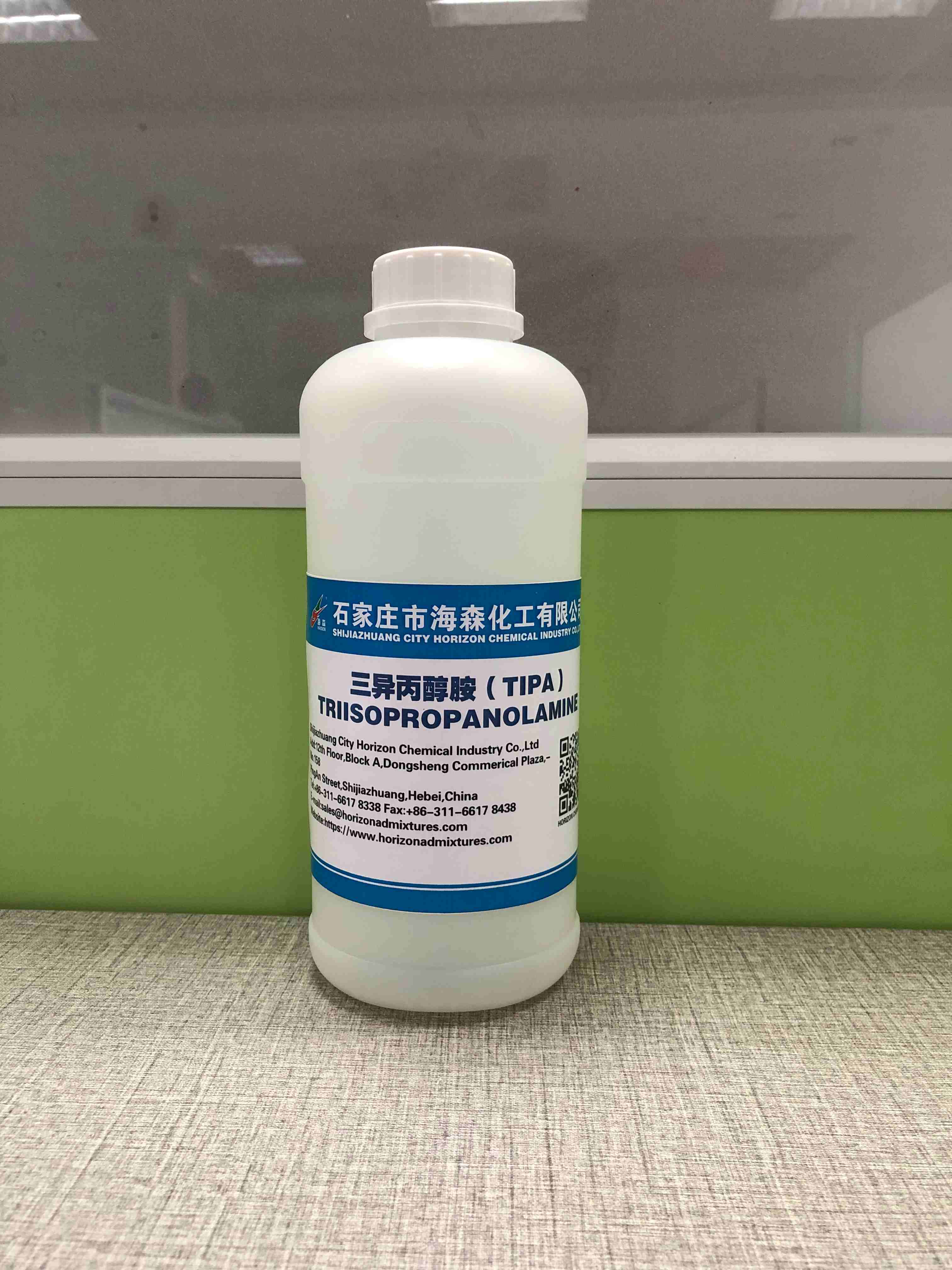
Triisopropanolamine, or TIPA, has rapidly emerged as a powerful ally in the cement industry, specifically for its ability to enhance late-stage strength development. Unlike traditional grinding aids that primarily focus on improving mill efficiency, TIPA functions at a molecular level by interacting with the hydration products of cement. Its unique chemical structure allows it to chelate with iron and aluminum ions during the hydration of ferrite and aluminate phases, preventing the formation of impermeable coatings around cement grains. This sustained reactivity encourages a more thorough and continuous hydration process, directly translating into higher compressive strengths at 28 days and beyond—a critical parameter for structural applications where long-term durability is non-negotiable.
What truly sets TIPA apart is its dual functionality: it not only boosts strength but also significantly enhances grinding efficiency. During the grinding phase, TIPA reduces particle agglomeration and minimizes the coating of grinding media, leading to a finer and more uniform particle size distribution. This finer grind itself contributes to improved early strength, but TIPA's chemical effect dominates later, as it promotes the formation of a denser, less permeable microstructure. Practical plant trials have shown that even a small dosage of TIPA can replace costlier, less effective alternatives, while simultaneously reducing clinker factor. The result is a win-win: producers save on raw material and energy costs, and the final product meets or exceeds rigorous performance standards.
Adopting TIPA is more than a minor formulation tweak—it represents a strategic shift in how grinding aids are perceived. Rather than being seen merely as process additives, compounds like TIPA are now recognized for their chemical contribution to cement's mechanical properties. Its ability to refine pore structure and lower total porosity also imparts enhanced resistance to aggressive environments, such as sulfate attack, which is a leading cause of premature degradation in concrete structures. For forward-thinking producers, integrating TIPA into their grinding circuits is not just about immediate gains; it's about delivering a superior, more resilient product that stands the test of time.
Stabilizing Formulations: TIPA in Coatings and Adhesives
Triisopropanolamine, commonly referred to as TIPA, plays a surprisingly versatile role in the world of industrial formulations. While it's often recognized for its pH-adjusting capabilities, its true value in coatings and adhesives goes much deeper. TIPA acts as a multifunctional stabilizer that touches everything from pigment dispersion to long-term storage integrity. If you've ever dealt with settling pigments or inconsistent viscosity after a few months on the shelf, you already understand the headache it causes. TIPA steps in not just as a neutralizer but as a dispersing aid that wraps around pigment particles, preventing agglomeration and keeping the whole system homogeneous. It's one of those ingredients that doesn't get the limelight but quietly holds the formulation together.
In two-component systems, especially waterborne epoxy adhesives, TIPA brings another layer of stability. It doubles as a curing accelerator and a stabilizer for the resin itself, helping to prolong pot life without sacrificing the final cure speed. This balancing act is critical because formulators are constantly walking a tightrope between reactivity and workability. The amine's steric bulk slows down unwanted side reactions during storage, yet once the system is triggered, it participates actively in crosslinking. What you end up with is a more predictable, controlled reaction profile that reduces batch-to-batch variability. That kind of reliability is gold when you're scaling up from lab trials to full production.
Another often overlooked aspect is TIPA's contribution to corrosion resistance in protective coatings. By stabilizing the binder matrix and minimizing micro-defects where moisture can sneak in, it helps maintain barrier properties over time. It doesn't get credit as a corrosion inhibitor in the traditional sense, but when you measure salt spray resistance or cyclic weathering, you can see the difference. Plus, its low volatility and compatibility with a wide range of co-solvents make it easier to work with than some of its more aggressive amine cousins. For anyone looking to improve the robustness of their coating or adhesive without completely reformulating, TIPA is worth a closer look.
pH Control and Beyond: TIPA’s Neutralizing Power
Triisopropanolamine (TIPA) is often pigeonholed as a simple pH adjuster, but its role stretches far beyond traditional neutralization. Unlike more aggressive amines, TIPA offers a gentle yet effective buffering profile that helps maintain steady pH levels without sudden swings. This subtle control is critical in formulations where delicate chemical equilibria define product performance—think metalworking fluids or waterborne coatings. It doesn’t just bring pH into range; it holds it there, cushioning the system against external factors like dilution or contamination that would otherwise send acidity levels spiraling.
What makes TIPA particularly versatile is its ability to pair with a variety of acids, creating buffer systems that can be tuned to specific application windows. In personal care, for instance, it’s not simply about reaching a skin-friendly pH. TIPA’s molecular structure allows it to interact with fatty acids to form soaps in situ, subtly adjusting viscosity and improving emulsion stability. That dual action—neutralization plus functional contribution—means formulators get more than a pH number on a meter; they get a tool that enhances texture and longevity without adding unnecessary complexity.
Industrial users prize TIPA for another reason: its low volatility and high stability under thermal stress. In high-temperature processes like gas scrubbing or cement grinding aids, the amine doesn’t evaporate or degrade easily, so the neutralizing power persists when other amines would have long dissipated. This staying power translates into more consistent process control and fewer top-ups, which is why engineers keep coming back to TIPA not just as a pH adjuster, but as a reliable partner in demanding environments where the job description goes well beyond a simple acid-base reaction.
Eco-Friendly Performance: TIPA’s Safety and Sustainability Edge
TIPA’s approach to packaging reimagines the familiar—films that behave like conventional plastic but break down without a trace of harm. This isn’t about trading convenience for a vague green claim. The material meets rigorous compostability standards, ensuring it disintegrates in home or industrial settings, leaving behind nutrient-rich soil rather than microplastic threats. It’s a quiet triumph of chemistry that lets everyday use feel effortlessly responsible.
Safety is woven into the very structure of these materials. Unlike many traditional plastics that rely on questionable additives, TIPA’s solutions are designed for direct food contact, free from bisphenols and phthalates. The manufacturing process itself sidesteps the toxic trail common to petrochemical-derived packaging. For brands and consumers, that means one less worry about what might be leaching into the products they love.
Beyond the moment of disposal, TIPA addresses the entire lifecycle. By sourcing renewable inputs and keeping end-of-life in mind from the start, it creates a genuine closed loop. There’s no compromise on the resilience or clarity that modern packaging demands—just a smarter path that leaves behind a lighter footprint without asking the user to sacrifice on performance.
TIPA vs. Traditional Amines: A Practical Comparison
When you look at the curing behavior of TIPA (triisopropanolamine) side-by-side with older amines like DETA or TETA, the differences in working time and viscosity jump out immediately. TIPA gives you a significantly longer pot life, often stretching to hours instead of minutes, without the sudden exotherm that can ruin larger pours or laminates. This slower, more controlled reaction isn't just about convenience—it directly reduces internal stresses in the cured epoxy, meaning fewer micro-cracks and better long-term adhesion on tricky substrates like damp concrete or oily steel.
On the handling side, traditional amines often come with a sharp, eye-watering odor and a lot more skin sensitization risk, forcing shops to invest heavily in ventilation and PPE. TIPA, by contrast, has a much lower vapor pressure and less aggressive smell, which makes it far more forgiving in enclosed work areas or when applying coatings by hand. Users frequently note that while TETA might give a quick hardness, it can leave the surface with a waxy, greasy feel if humidity isn't perfect—a problem TIPA-based systems generally shrug off.
Cost-wise, it’s easy to fixate on the higher per-kilo price of TIPA compared to commodity amines, but the equation shifts when you factor in scrap reduction, fewer rejected batches, and the ability to work without expensive climate controls. In thick sections or civil engineering grouts, where thermal runaway is a real danger, TIPA’s mild heat release profile isn't just a nice-to-have—it can be the difference between a successful pour and a cracked mess that needs jackhammering out the next day. That kind of reliability quietly tips the scales in real-world projects.
FAQ
Triisopropanolamine, often abbreviated as TIPA, is a tertiary amine derived from a mixture of isopropanolamines. Its unique molecular structure gives it a combination of hydroxyl and amino groups, making it highly effective as a neutralizer, emulsifier, and crosslinking agent. Unlike more common amines, TIPA's steric hindrance and multiple reactive sites allow it to perform in demanding applications where other chemicals fall short, such as in high-temperature cement grinding or stabilizing sensitive polymer dispersions.
In cement manufacturing, TIPA acts primarily as a grinding aid and quality improver. It prevents particle agglomeration during the milling process, which reduces energy consumption and increases mill throughput. Beyond that, it modifies the surface chemistry of cement particles, improving their dispersion and hydration behavior. This leads to better strength development, especially in blended cements containing supplementary cementitious materials like fly ash or slag, where it activates latent reactivity.
TIPA's influence extends into concrete performance as well. When used in admixtures, it can significantly boost early-age strength without compromising workability. It works by accelerating the hydration of key cement phases, particularly enhancing the dissolution of ferrite and aluminate phases. This results in denser microstructure formation, reduced porosity, and improved durability against chemical attacks, which is crucial for infrastructure exposed to aggressive environments like marine or industrial zones.
Absolutely. Its versatility shines in several niche industrial domains. For instance, it serves as a corrosion inhibitor in metalworking fluids and lubricants, where it forms a protective film on metal surfaces. In paints and coatings, TIPA functions as a pH adjuster and co-dispersant, helping pigments stay evenly distributed while maintaining low odor. It's also employed in the production of synthetic resins and as an intermediate in manufacturing other specialty chemicals, such as surfactants and herbicides.
One of the key advantages is its low toxicity profile compared to many alternative amines. It's biodegradable and has a lower environmental persistence, making it a more sustainable choice for formulators. Additionally, by improving the efficiency of industrial processes like cement grinding, it indirectly reduces carbon emissions and energy use. In formulations, its low vapor pressure minimizes worker exposure to harmful fumes, contributing to safer handling conditions in manufacturing plants.
In waterborne coatings, TIPA offers excellent pigment wetting and stabilization without the strong ammonia-like odor that plagues many volatile amines. Its high boiling point and low volatility mean it stays in the film during drying to maintain pH balance and prevent flash rusting. Moreover, it doesn't contribute to yellowing over time, which is a common issue with some alternative neutralizing agents. These properties make it ideal for producing high-performance, durable architectural and industrial coatings.
The molecule's three isopropanol groups create a steric shield that reduces unwanted side reactions while still allowing the nitrogen center to interact with acidic species or metallic surfaces. This balance of steric protection and nucleophilic action makes it a selective catalyst or stabilizer. For example, in polyester resin production, it can act as a chain extender without causing premature gelation. The hydroxyl groups also improve water solubility and provide sites for further chemical modification, broadening its utility across different chemistries.
Formulators should consider TIPA's high viscosity and alkaline nature when designing mixing processes. Pre-warming or diluting it may be necessary for easier handling. Compatibility testing is also advised, as it can interact with certain acidic raw materials or metal catalysts. Storage in corrosion-resistant containers and avoiding prolonged exposure to air prevent color development. When used correctly, however, it offers unmatched formulation flexibility—from enhancing the shelf life of agricultural formulations to acting as a reactive diluent in epoxy systems.
Conclusion
Triisopropanolamine (TIPA) is much more than a simple amine; its molecular structure equips it with a versatile reactivity that underpins its wide industrial use. In cement production, TIPA serves as a revolutionary grinding aid that not only enhances milling efficiency but also significantly boosts the final cement strength by optimizing particle distribution and promoting hydration. This dual function reduces energy consumption while upgrading material performance. Beyond construction, TIPA's ability to stabilize formulations is evident in coatings and adhesives, where it prevents pigment settling and ensures uniform application and durability. Its tailored hydroxyl and amine groups allow it to interact with various binders, acting as a compatibility bridge that maintains product integrity over time.
Equally valuable is TIPA's role in pH control; it provides gradual, long-lasting neutralization without the sharp spikes associated with inorganic bases, making it ideal for personal care and industrial cleaners. Its eco-friendly profile further strengthens its appeal—biodegradable and low in toxicity, TIPA aligns with modern sustainability goals without compromising on performance. When compared to traditional amines like triethanolamine, TIPA exhibits superior grinding efficiency and lower volatility, making it a safer, more effective alternative. This combination of functional adaptability, environmental safety, and measurable performance advantages positions TIPA as a standout solution in industrial chemistry, driving innovation across sectors from construction to consumer goods.
Contact Us
Contact Person: Sam Lee
Email: [email protected]
Tel/WhatsApp: 86-311-6617 8338
Website: https://www.horizonadmixtures.com/