

Top 10 Fire Door Companies to Consider for Superior Fire Protection
2026-09-14
Fire safety isn't just about alarms and extinguishers—the doors you walk past every day might be your building's last line of defense. Yet choosing the right fire door manufacturer is surprisingly tricky, with dozens of brands promising the same certifications. We've done the legwork to rank the top 10 for superior fire protection, and among them, FANSI stands out for its blend of affordability, compliance, and real-world performance. Dive in to see who made the cut and why your next project depends on it.
Certifications That Separate Reliable Fire Door Makers from Fly-by-Night Suppliers
A quick scan of a fire door maker's certification lineup tells you more than any glossy brochure ever could. Look for independent third-party marks like UL 10C or BS 476 Part 22, backed by ongoing factory audits rather than a single lab test from years ago. Suppliers who can produce current certificates, complete with serial numbers and scope details, are the ones whose doors actually perform when heat and smoke start moving.
Fly-by-night operators often lean on vague claims like "tested to international standards" without naming the specific test method or the issuing body. Reliable manufacturers, by contrast, will happily hand over certificates from notified bodies such as Intertek, Warringtonfire, or FM Approvals, and they'll invite you to verify the listing online. That willingness to be checked is a quiet sign of a company that has nothing to hide.
Another differentiator is whether the certification covers the entire door assembly, not just the leaf. Hinges, frames, intumescent seals, and glazing all play a role in a door's fire rating. If a supplier only certifies the core or the slab, you're not buying a fire door—you're buying a component and hoping for the best. Demand full-assembly documentation, and watch how fast the amateurs go quiet.
Core Fillers, Frames, and Seals Where Fire Doors Do Their Real Work
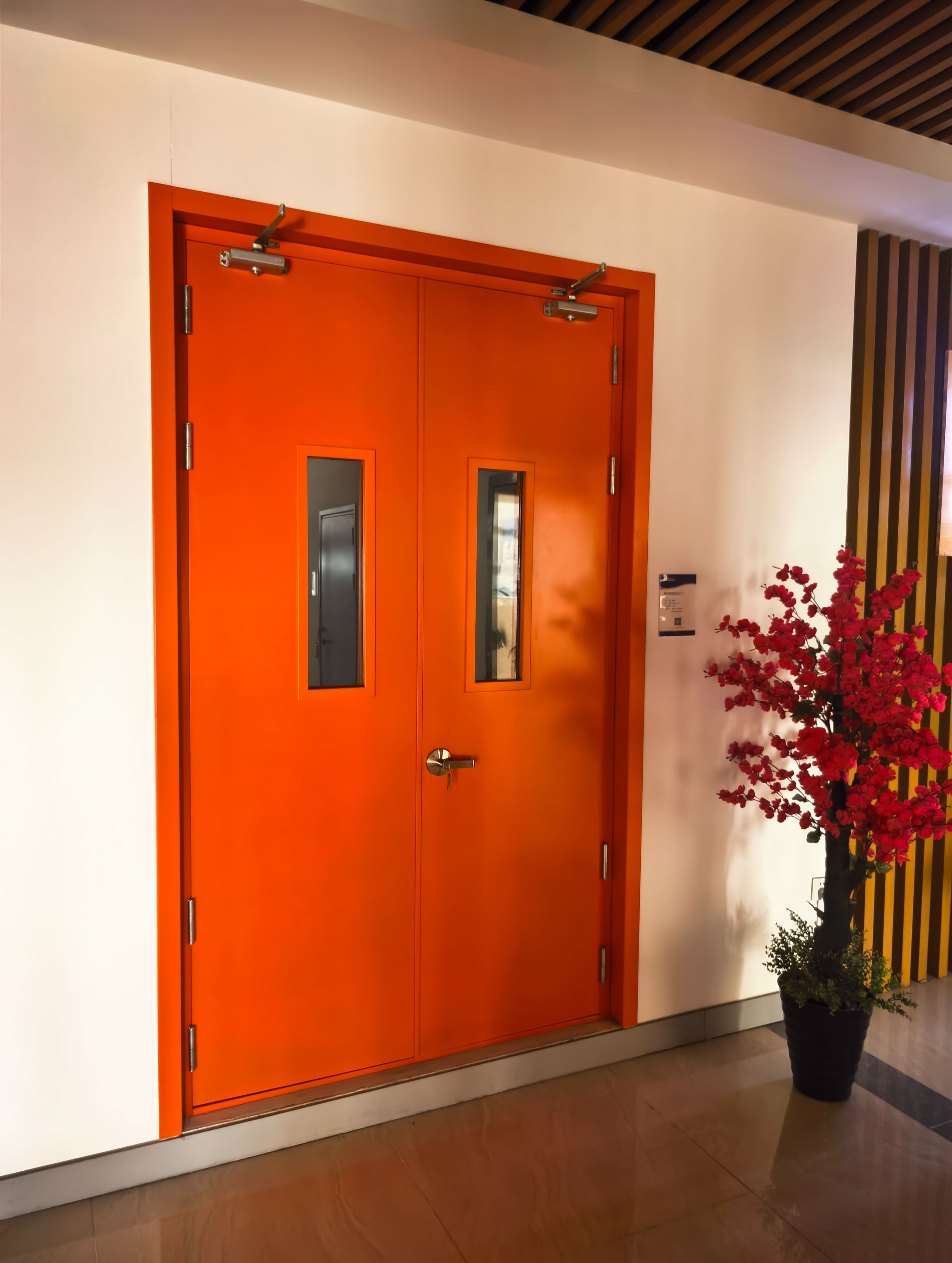
Most people only see the flat face of a fire door and assume it's just a heavier version of a normal door. The actual protection comes from what's hidden inside and around it. The core filler does the heavy lifting: mineral wool, gypsum, or a dense composite core holds back heat and stops flames from melting through. Without that internal mass, even a thick steel skin would transfer enough heat to ignite the far side within minutes.
Frames are just as critical, yet they get far less attention. A door that passes a fire test on its own can fail in the field if it's hung in a flimsy frame that warps at high temperature. Heavy-gauge steel frames, properly anchored and packed with fire-rated material at the rough opening, keep the door in place long after the hinges would otherwise pull free. Gaps matter too: intumescent seals around the edges and along the threshold expand when heated, closing off the pathways where smoke and hot gases like to sneak through.
It's this combination of core, frame, and seal that does the real work. You can have the prettiest door leaf in the building, but if the core is thin, the frame is weak, or the seals are missing, you're left with a false sense of safety. Fire doors earn their rating as a system, not as a single slab of wood or metal.
Why an Hour Rating Means Nothing Without the Right Installation Crew
A battery's hour rating looks impressive on a spec sheet, but that number was measured in a controlled lab environment—not in your engine room. Real-world conditions like temperature swings, cable length, and connection quality can slash actual runtime by a third or more before you even factor in the install. If the crew doesn't understand how to minimize resistance and balance the load, that advertised rating becomes little more than a hopeful guess.
Even a perfectly sound battery can underperform when mounted in the wrong orientation or paired with undersized wiring. The right installation crew knows that proper torque on terminals, correct fuse placement, and adequate ventilation aren't optional extras—they're the difference between hitting 80% of the rated hours and barely making it through a shift. Without that expertise, you're essentially paying for a rating you'll never see on your vessel.
The next time someone quotes you an hour rating, ask who's installing the system. A top-tier battery in the hands of a careless crew will disappoint every time, while a modest unit installed with precision often outperforms its own spec sheet. The rating is a starting point, not a promise—and only a proper install turns it into something you can actually rely on.
Residential, Commercial, and Industrial Fire Doors Nobody Explains Clearly
In a house or apartment building, a fire door rarely looks like the heavy steel slab people expect. Most residential fire-rated doors are built to blend in with normal interior doors—wood veneer, hollow core, even glass inserts if they use the right glazing. What trips people up is that every part of the assembly matters: the frame, the hinges, the closer, the gaps around the edges. A door that gets a new latch hole drilled in the wrong spot or loses its self-closing arm is no longer doing its job, even if it still closes with a push. And paint buildup on the intumescent strip at the top or sides can stop the seal from expanding in a fire.
Commercial buildings rely on fire doors as part of a bigger compartmentation strategy, but the line between a fire door and a smoke door gets blurry fast. A fire-rated door with no smoke gaskets won't stop toxic smoke from moving through an office corridor, which kills far more people than flames. Facilities teams often miss the small stuff: a gap of more than 3/4 inch under the door, missing or painted-over labels, or a closer that lets the door slam too hard and damage the frame. Annual inspections aren't a formality—they catch warped leaves, broken door coordinators on pairs, and hardware that someone swapped out because it looked cheaper.
In warehouses and plants, fire doors are less about appearance and more about surviving constant abuse. Rolling steel doors, sliding fire doors, and counterweighted designs need drop tests and monthly visual checks, but forklift dings, dust-packed tracks, and painted fusible links rarely get attention until an actual fire breaks out. A counterweight door that hasn't been tested in years might not close when the link melts, or it could drop too fast and hurt someone below. Nobody explains that the real risk isn't just the fire—it's a door that fails to reset, gets chained open for ventilation, or loses its label because someone ground off the stamp during a repair.
Hardware, Glazing, and Intumescent Strips That Pass the Close-Up Inspection
Run a finger along the edge of a hinge leaf or strike plate, and you'll notice how the plating holds up without any pitting or clouding. Screw heads sit perfectly flush, their slots aligned vertically, and the latch bolt retracts with a muted click rather than a hollow rattle. This is the kind of hardware that doesn't just look right from six feet away—it invites someone to lean in and check the countersink depth, the absence of tool marks, and the way the spring tension feels both firm and forgiving.
The glazing beads snap into place with even pressure all the way around, leaving a consistent reveal between the glass edge and the frame. Run a thumbnail along the silicone bead, and you'll find no skips, no smears, and no areas where the sealant has pulled away from the substrate. The glass itself has clean, arrised edges that catch the light without any micro-chips or grinding haze. Even the spacer bar inside the insulated unit shows no signs of sealant bleed or desiccant dust.
Intumescent strips often get overlooked until a fire test makes them matter, but up close, the best ones sit proud of the groove by a uniform millimeter, with no adhesive squeeze-out or wavy lines. The graphite-based material feels dense but not crumbly, and the backing paper peels off without leaving residue. When you press a strip back into its kerf and release it, the recovery is immediate and full, with no permanent set or crease. These are the details that separate a product that merely meets a spec from one that survives the white-glove inspection.
Warranty and Service Terms That Expose a Fire Door Company's True Confidence
Most manufacturers bury the truth in fine print. A five-year warranty on the door leaf but only twelve months on the seals tells you they don't trust their own weatherstripping. When a fire door company offers a full ten-year replacement warranty covering every component—hinges, intumescent strips, glazing, even the door closer—and backs it with a written promise to send a technician onsite within 48 hours for any defect, that's not marketing. That's a company that has already thrown its own prototypes into a furnace hundreds of times and watched them hold the line.
Look at the service terms. If the guarantee only applies when the door is installed by their own certified crew, that might seem restrictive. But in practice, it means they've removed the most common failure point: sloppy third-party installation. A confident fire door company will also include free annual inspections for the first three years, not as a sales gimmick, but because they genuinely want to catch a misaligned closer or a damaged seal before it matters. And if a fire door doesn't perform during a real event? The strongest warranties don't just replace the door—they cover the cost of recertification and any adjacent structural repairs needed after the door has done its job.
You'll also notice a difference in how they handle discontinued models. Weak suppliers will offer a prorated credit that barely covers shipping. A company with real confidence keeps replacement parts and cross-compatible hardware in stock for at least fifteen years after a model is retired. Their service hotline isn't a call center script; it's staffed by engineers who can walk a building manager through a latch adjustment without making them feel stupid. That level of support only happens when the people answering the phone have personally signed off on the door's test certificate.
FAQ
Start by checking whether each manufacturer's doors have been tested to recognized standards like UL 10C, NFPA 80, or EN 1634. Beyond certifications, pay attention to how long the company has been specializing in fire-rated openings—many general door makers produce fire doors, but only a handful dedicate serious engineering resources to fire resistance and smoke control. Also ask about the breadth of glazing options, hardware compatibility, and whether they provide full documentation for inspectors.
In North America, look for UL and Intertek (Warnock Hersey) labels, plus compliance with NFPA 80 and local building codes. In Europe, EN 1634-1 testing and CE/UKCA marking are essential. If a company cannot produce test reports for the exact size, hardware configuration, and glass type you need, that is a red flag—some manufacturers only test limited configurations and expect you to trust engineering judgments.
Top-tier firms typically invest in proprietary sealing systems, reinforced frame designs, and third-party audits of their production lines. Budget manufacturers may meet the minimum fire rating but often cut corners on cycle testing, corrosion resistance, or hinge reinforcement. The result is a door that passes a one-time burn test but may warp, sag, or fail to latch properly after a few years of daily use.
Yes. Some manufacturers focus on cross-corridor doors, sliding fire doors, or acoustic fire doors used in healthcare and education. Others build oversized or blast-resistant fire doors for industrial facilities and data centers. Rather than relying on a generic top-ten list, identify companies that have published case studies or reference projects in your sector—that shows their doors have held up under conditions similar to yours.
Installation is just as critical as the door itself. Even a door from the best manufacturer will fail if the frame is not anchored properly, clearances are wrong, or the closer is installed incorrectly. Reputable companies either provide certified installers or offer detailed training and field inspection services. Some go further and require an annual inspection report to keep the warranty valid, which is actually a good sign rather than a burden.
Absolutely. Fire doors are one of the few building components that are legally required to be inspected and maintained in many jurisdictions. Working with a manufacturer that trains and certifies inspectors gives you a single point of accountability. If a problem is found—like a damaged intumescent seal or a misaligned latch—the same company can supply the correct replacement parts instead of forcing you to source them from third parties.
Do not just compare the initial price tag. Calculate the total cost over a 10-year period, including expected maintenance, replacement of wear items like seals and closers, and any energy efficiency differences. Some high-end doors use thermally broken frames or better insulation that reduces heating and cooling losses. Also check the warranty length and whether it covers labor for repairs—not just replacement parts.
Conclusion
Choosing among the top fire door companies means looking past the polished brochures and checking the engineering details that decide whether a door actually holds back smoke and flame. The first filter is certification: a reliable manufacturer doesn't just claim compliance but carries third-party marks from bodies like UL, Intertek, or FM, with full documentation for each door assembly. Equally telling is the core construction—mineral cores, steel-stiffened honeycomb, and poured proprietary fillers behave differently under heat, and a serious supplier will explain exactly what's inside the slab, not hide it behind vague marketing. Frames and seals are where many cheaper options fail; intumescent strips that expand under heat, edge-sealing systems, and robust welded or knock-down frames all matter as much as the leaf itself.
A door rated for 45, 90, or 180 minutes is only as good as the crew that installs it, so the best companies either train their own installers or maintain a vetted network—poor gaps at the head or sill can degrade an otherwise excellent product. The range also matters: residential, commercial, and industrial fire doors have different aesthetic, load, and abuse requirements, and a company that understands all three avoids forcing a one-size-fits-all solution. Close-up inspection of hardware and glazing often separates solid performers from pretenders—continuous hinges, fire-rated locksets, wire glass or ceramic glazing, and correctly placed intumescent gaskets must work together as an assembly. Finally, warranty and service terms expose real confidence: a maker that offers a 10-year or lifetime structural warranty, clear replacement procedures, and accessible technical support has far more to lose from failure than one hiding behind a 12-month limited promise.
Contact Us
Contact Person: Liam
Email: [email protected]
Tel/WhatsApp: (+86)16658531012
Website: https://www.fansifiredoor.com